

Girl, explain: Agentic. MCP. Tokens. Help.
A glossary of AI terms and tech-bro jargon, so you can pretend to understand.
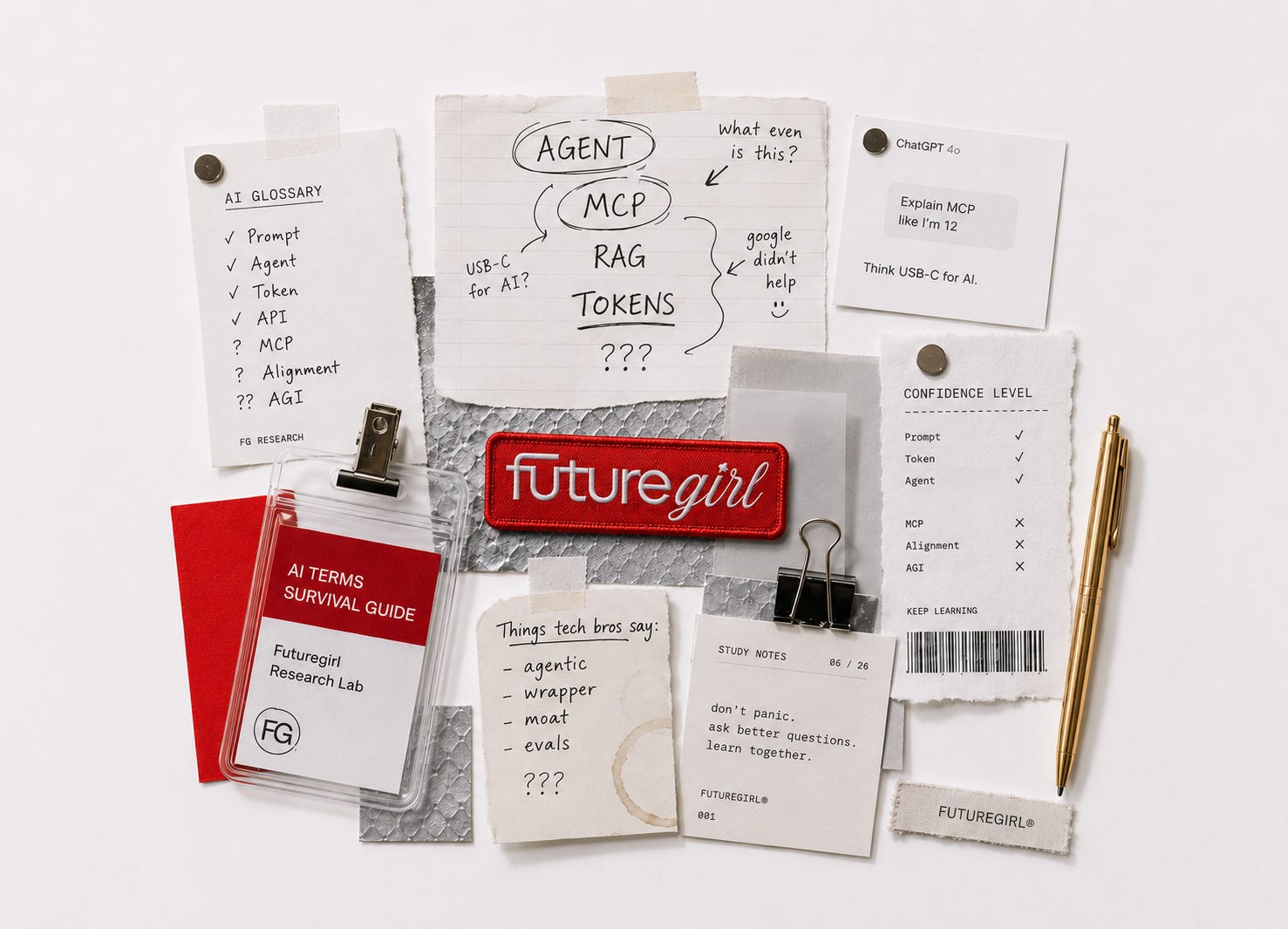
Raise your hand if you ever said: “I’m gonna be the cool mom (or auntie).”
Because I did. And I really thought I would be.
But at 34, I’ve already given up.
It happened right around the time when the kids started 6-7’ing. “So dumb,” I said monotonously, over my wines-and-ciggies dinner. “So dumb,” Gen Z would probably comment on my poor life choices (the remnants of the 00s skinny bitch diet era).
I’m clueless about teenage terms. Internet memes. Rap references. Even my own language’s social slang (Dutch).
Granted, my aversion to keeping up with the hype terms might be years of marketing PTSD.
I mean, do you even know marketing if you don’t speak using words like GEO, OKRs, and UGC? The bigger the buzzword bingo, the more the room nods in agreement, the likelier everyone thinks you’re capable.
So for that reason, let’s learn AI terms. The ones you’ll likely come across as you start exploring this space.
Read through and add the AI terms you’re still confused about in the comments.
We’ll figure it out, together. 🙆♀️
Terms you’ll hear when people explain AI
AI (Artificial Intelligence)
Computers that can perform tasks that normally require human intelligence, such as writing, reasoning, recognizing images, or answering questions.
Machine Learning (ML)
A way of teaching computers through examples rather than instructions. Show it thousands of apples, and it learns what makes an apple an apple.
Deep Learning
A more advanced type of machine learning that learns from massive amounts of data. Show it millions of apples, and it can recognize far more complex patterns and details. It’s the tech behind ChatGPT, image generators, and voice assistants.
Model
The AI itself (GPT, Claude, Gemini). When someone says “We’re testing a different model,” they mean “We’re trying a different AI.”
LLM (Large Language Model)
A type of AI trained on enormous amounts of text that can understand and generate language. ChatGPT uses it.
Foundation Model
The powerful AI underneath the apps you use. ChatGPT, Claude, Gemini, and Llama are foundation models that thousands of companies build on top of.
Training
The process of teaching an AI by showing it huge amounts of data and helping it learn patterns, relationships, and concepts.
We’re all using Claude now (apparently), so I wrote you a setup guide

ChatGPT who? All I hear is Claude, Claude, Claude. It’s giving team Apple vs. Android.
Terms you’ll hear when using AI
Prompt
The instruction you give an AI.
Prompt Engineering
The art of asking AI in a way that gets better results. As AI models improve, this is less about secret “tricks” and more about giving clear instructions, context, and examples.
Context Engineering
Giving AI the right information, tools, instructions, and examples so it can perform a task effectively. This will likely become more important than prompt engineering.
Context Window
AI’s short-term memory. The larger the context window, the more emails, documents, notes, or instructions it can keep track of at once. This is why people get excited whenever a new model has a bigger context window.
Token
How AI counts text. A token might be a word, part of a word, or even punctuation. AI companies often charge by tokens, which is why you’ll hear people obsessing over token limits and token costs.
Reasoning Model
An AI model that thinks before it speaks. Rather than giving the fastest answer possible, it spends extra time working through a problem. This is why reasoning models are often used for research, coding, maths, and complex tasks.
RAG (Retrieval-Augmented Generation)
AI with access to notes. Instead of relying only on what it learned during training, it can search documents, databases, or company knowledge before answering. This is one of the main ways businesses make AI more useful and accurate.
Hallucination
When AI makes something up and presents it with the confidence of a bro explaining crypto in 2021. Think incorrect citations and fake statistics. One of the biggest reasons people still double-check AI's work.
Copilot
An AI sidekick that helps you work faster while you stay in charge.
Automation
Using AI to handle repetitive work automatically.
Is the future of work being outside more?

“All content reads exactly the same,” says everyone, every day.
Terms you’ll hear at AI startups
Agent
An AI that doesn't just answer questions but actually does things (researching, sending emails, booking meetings, etc.). Agents are one of the hottest topics in AI because they're moving from “assistant” territory into “digital employee” territory.
Agentic AI
AI that can work toward a goal with limited human guidance. It's one of the most overused buzzwords in AI right now, but generally, people use it to describe systems that can act rather than simply respond.
API
A way for apps and software to communicate. Whenever you hear founders talk about integrating AI into products, APIs are usually the thing making it possible behind the scenes.
Tool Calling
When AI reaches outside itself to get things done. Instead of only generating text, it can search the web, check your calendar, send messages, or use software tools. This is one of the building blocks behind AI agents.
MCP (Model Context Protocol)
A shared language that helps AI connect to apps, tools, and data. You could describe MCP as “USB-C for AI” because it makes it easier for different systems to work together without building custom connections every time.
AI Wrapper
A company that builds on top of GPT, Claude, or another AI model rather than creating its own. Many successful AI businesses are technically wrappers.
Vertical AI
AI built for one specific industry. Instead of helping everyone with everything, it might focus entirely on lawyers, doctors, or accountants. Many investors believe this is where some of the biggest AI opportunities are.
AI Native
A company that was born in the AI era and built around AI from the start.
AI First
A company that has reorganized itself to make AI a core part of how it operates and creates value.
Moat
The thing that stops competitors from copying you. In AI, people obsess over moats because the underlying models are increasingly available to everyone.
Terms the Internet loooves
AI Slop
Generic AI-generated content nobody really wanted. Think spammy blog posts, recycled LinkedIn takes, and endless content created because AI made it easy.
Trendslop
AI-generated advice that sounds insightful but mostly recycles popular trends and buzzwords instead of providing genuinely original or context-specific thinking.
Vibe Coding
Building software by telling AI what you want and letting it figure out most of the code. It's become popular because non-techies can now build things too.
Agent Washing
Rebranding a chatbot as an “agent” because it sounds cooler in investor meetings.
Terms you’ll hear in AI debates
AGI (Artificial General Intelligence)
A hypothetical AI that could do most cognitive tasks as well as a human. People disagree wildly on whether it's five years away, fifty years away, or impossible.
Superintelligence
A hypothetical AI that would surpass humans in nearly every intellectual task. It doesn’t exist today, but it’s a common topic in discussions about the future of AI.
Alignment
The challenge of making sure AI does what humans actually want, rather than what it thinks we want. This might be one of the most important long-term AI problems.
Frontier Model
The smartest AI models available today. People usually refer to GPT, Claude, Gemini, or whatever gets announced next week.
Things tech bros say, translated
“We’re building an agentic workflow.”
We’ve connected AI to tools so it can complete tasks instead of just answering questions.
“We’re seeing strong agent adoption.”
People are actually using the AI feature.
“We’re adding MCP support.”
We’re making it easier for AI tools to connect to our product.
“Everything is becoming a wrapper.”
Many new AI companies are built on top of the same underlying models.
“The real bottleneck is context.”
The AI isn’t the problem. The challenge is giving it the right information.
“We’re still figuring out the evals.”
We’re not yet sure how reliable the AI is.